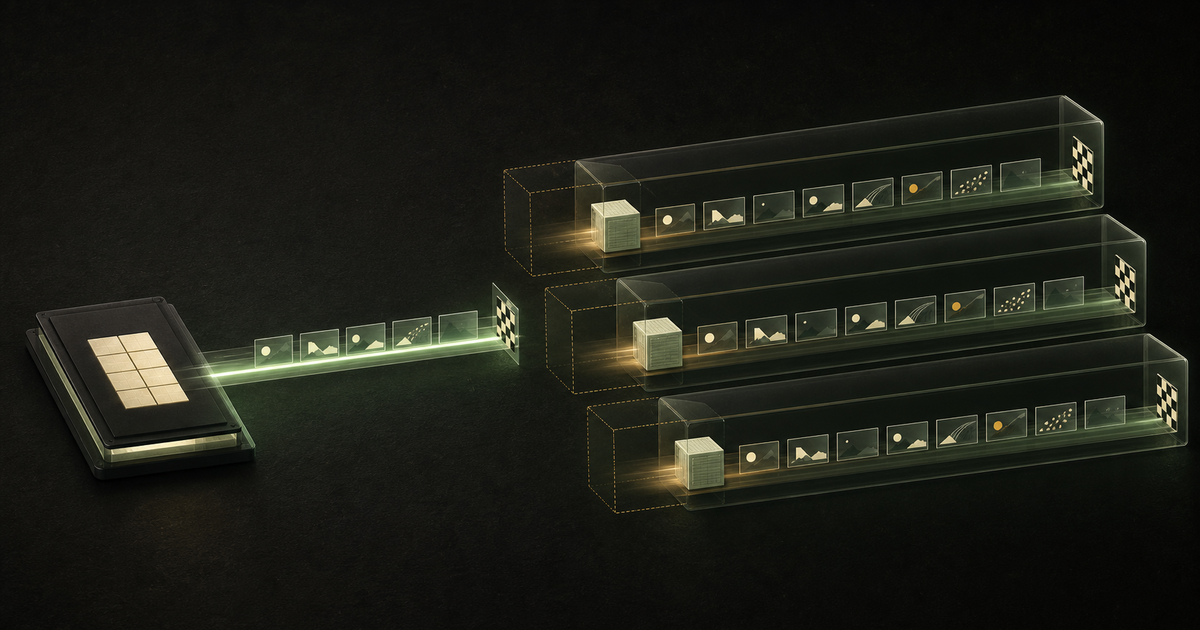
A media API that offers h264_videotoolbox is making a hardware claim. Listing the encoder in ffmpeg -encoders does not prove a Media Engine session can actually produce a frame. RenderMac treats that gap as a routing bug: ffmpeg.transcode.v1 defaults video_codec to h264_videotoolbox, so a device that cannot encode must not appear in the quote cell or receive the lease.
This note reports two MEASURED bakeoffs and the fail-closed probe that the shipping agent and matcher use. It does not argue that Apple Silicon always wins, that a Linux guest will never gain hardware encode, or that a single Mac beats a fan-out service we did not run.
Encoder lists are not a capability
FfmpegTranscodeInputSchema in packages/shared/src/protocol.ts allows only h264_videotoolbox and libx264, and defaults to VideoToolbox. The transcode runner then builds argv from that enum (-c:v plus either -b:v 2M or -crf 23). Buyers never pass an encoder name as a free string.
A second, packaging-only check exists in scripts/build_native_app.sh: the ad-hoc Apple Silicon DMG refuses to copy FFmpeg unless ffmpeg -encoders contains h264_videotoolbox. That is a binary-content gate for the bundle. It is not how a live host proves the encoder works. The runtime probe, below, actually encodes.
The runtime probe encodes one frame
packages/agent/src/capabilityProbes.ts returns { videotoolbox_hw, metal, ane }. On non-Darwin it returns false for VideoToolbox. On Darwin it runs FFmpeg against a generated lavfi source and a null muxer, with a 20 s timeout:
ffmpeg -v error -f lavfi -i color=c=black:s=64x64:d=0.05
  -frames:v 1 -c:v h264_videotoolbox -f null -
Any non-zero exit is videotoolbox_hw: false. The agent does not parse --encoders. Metal is a separate, conservative parse of system_profiler SPDisplaysDataType -json: both spdisplays_mtlgpufamilysupport and spdisplays_metal must appear in the JSON text, and invalid JSON is false (packages/agent/src/hostPolicy.test.ts). ANE is hardcoded false because the agent has no stable public execution probe; unknown is not advertised.
Quote and lease both consume that boolean. assessCapacity appends videotoolbox_hw to the capacity cell when ffmpeg.transcode.v1 requests VideoToolbox (the default codec), then filters devices with NOT $6 OR COALESCE((capability_probes->>'videotoolbox_hw')::boolean, FALSE). The matcher applies the same rule when selecting a queued job for a pulling device: a VideoToolbox transcode is ineligible unless device.capability_probes?.videotoolbox_hw is true. An integration test in packages/control-plane/src/integration/controlPlane.integration.test.ts inserts one probed and one unprobed device; VideoToolbox capacity reports eligibleDevices === 1 and a cell ending in videotoolbox_hw, software x264 sees both devices, and the unprobed host is offered only the libx264 job.
MEASURED 20-minute 1080p30 encode, 2026-07-22
Hardware: Apple M2 Max, 96 GB, Mac14,5 (MBP14M2Max96GB.lan). Date stamp 2026-07-22T053512Z for the native encodes and 2026-07-22T054542Z for the Cloudflare-shaped Docker job. Concurrency: 1 (sequential /usr/bin/time -p wraps). Source: 20 minutes of 1920×1080@30 lavfi testsrc (36 000 frames). The ultrafast generate step is scaffolding, not the sellable job (MEASURED 147.8 s on the same M2 Max).
Native FFmpeg (Homebrew on PATH) then re-encoded that file:
| Step (concurrency 1, M2 Max, 2026-07-22) | Wall | Label |
|---|---|---|
h264_videotoolbox -b:v 8M, audio copy | 95.14 s | MEASURED |
libx264 medium CRF23, audio copy | 102.79 s | MEASURED |
The cloud contrast used the same libx264 command inside Docker --cpus=0.5 --memory=4g on that same Mac, chosen to resemble Cloudflare Containers standard-1 (4 GiB, 0.5 vCPU). MEASURED wall was 2371.1 s. There is no VideoToolbox path in that Linux shape. M1 Air ffmpeg rows were blocked: Homebrew/ffmpeg were missing on SSH PATH; earlier silver logs with real 0.00 were discarded as invalid.
Versus the same-host Mac x264, the CF-shape job was about 23× slower wall (2371.1 / 102.79). Versus VideoToolbox the ratio is larger, but that comparison is not codec-matched: 8 Mbps hardware H.264 versus CRF23 software x264. The honest paired contrast is Mac x264 versus CF-shape x264; VideoToolbox is the Mac-only extra path.
A published Cloudflare Containers rate card times that 2371.1 s wall gives an upper-bound compute estimate of about $0.0474 (est_cf_compute_usd_upper in ffmpeg-20m-cf-shape-2026-07-22T054542Z/ffmpeg-summary.json, method published rates × docker wall). That is a rate-card estimate, not a Cloudflare invoice. We did not read a billing export.
Public table for this bakeoff: VideoToolbox vs cloud encode.
The shipping transcode runner uses -b:v 2M for VideoToolbox, not the bench’s 8 Mbps, so product jobs are not claimed to match these 95.14 s.
MEASURED Remotion native versus four runtimes, 2026-07-25
Hardware: the same Apple M2 Max, 12 logical host CPUs, 96 GB RAM, macOS 26.5.1, Apple container CLI 1.1.0. Date: 2026-07-25 (virtualization-full-2026-07-25, host created_utc 2026-07-25T20:08:50Z). Workload: Remotion 4.0.381, 1920×1080@30, compositions LightMotion (150 frames), MediumMotion (300), HeavyMotion (450). Concurrency: 4 for every runtime. Linux guests: 4 vCPU / 8 GB, one shared ARM64 Debian/Chromium OCI image. Policy: one uncounted LightMotion warm-up, then three measured iterations; medians below. Native used Remotion’s macOS browser; Linux used Chromium in the image, so native-versus-Linux is a combined OS/browser/VM path. The three Linux rows are the cleaner runtime comparison.
| Runtime (M2 Max, 2026-07-25, concurrency 4) | Light median | Medium median | Heavy median | Heavy vs native |
|---|---|---|---|---|
| Native macOS | 3.480 s | 7.072 s | 30.753 s | 1.00× |
| Colima Docker / VZ | 11.152 s | 22.303 s | 97.668 s | 3.18× |
Apple container run | 10.864 s | 22.410 s | 98.168 s | 3.19× |
| Apple Container machine | 10.094 s | 21.882 s | 95.018 s | 3.09× |
All 36 measured renders completed with nonempty MP4 outputs (virtualization-full-2026-07-25/summary.json). Container machine was the fastest Linux option by a modest margin (HeavyMotion about 2.7% faster than Colima VZ and 3.2% faster than per-container VM) and remained about 3.1× slower than native. Process launch overhead was 0.235 s native, 0.355 s on a warm Container machine, 0.371 s Colima (VM already up), and 1.295 s for Apple per-container VM. Container machine cold-restarted and ran node --version in 0.728 s; first local image create-and-boot was 1.179 s. Startup is small next to a 30–100 s render.
The host FFmpeg advertised h264_videotoolbox, hevc_videotoolbox, and prores_videotoolbox. The identical Linux image under Colima, Apple per-container VM, and Container machine advertised no VideoToolbox encoders and had no /dev/dri. That is a MEASURED guest-capability result for this configuration, not a prediction about every future Containerization API.
Public table and per-trial listing: Apple Container machine vs native.
A separate 2026-07-22 Remotion fleet on the same M2 Max plus two M1 Airs (wall-clock only on the Airs; ffmpeg absent) is not mixed into the 2026-07-25 medians. MEASURED LightMotion there was 3.47 s (M2 Max), 8.78 s and 8.66 s (M1 Airs). Cloudflare Containers live (declared standard → standard-1, 0.5 vCPU / 4 GiB) finished the same LightMotion in 54.12 s and LongKinetic3m (5400 frames / 3:00 output) in 2175.3 s; the M2 Max LongKinetic3m was 111.54 s (concurrency unset in that suite JSON). A 20-minute CF-live LongKinetic row of 14502 s is PROJECTED (2175.3 × 20/3), not measured. Remotion Lambda was not run.
What the numbers change in the scheduler
ADR 0011 keeps launch execution as fixed, signed native services so VideoToolbox remains reachable. ADR 0012 records the 2026-07-25 3.09× HeavyMotion result as evidence for a future host Isolation mode; that mode, the VM supervisor, and a buyer confidential tier are accepted roadmap and are not implemented. FailClosedMacosVmSupervisor exists as a typed stub that refuses rather than silently host-sandboxing a job that required a VM, and it is not wired into the agent CLI.
The bakeoff therefore supports a product default, not a universal ranking: keep VideoToolbox transcodes on probed native macOS; do not pretend a 0.5 vCPU x264 container is the same service; do not pay a measured ~3× Remotion penalty for a Linux guest that still lacks the Media Engine in this setup.
Limits
We do not claim Apple Silicon always wins. Scope is one M2 Max, two M1 Airs for some Remotion walls only, and one Cloudflare Containers shape (live standard-1 and a Docker --cpus=0.5 --memory=4g stand-in). We did not run Remotion Lambda, Blender, GPU-cloud H.264, or a temperature-controlled lab. The 2026-07-25 suite used three iterations on an active development Mac; native-versus-Linux mixed browser builds. Apple per-container guests reported five visible processors with a cgroup quota of four CPUs. Encode power was not sampled. Cloudflare dollar figures in the artifacts are rate-card estimates, not invoices; we omit them as costs of record. PROJECTED 20-minute CF Remotion (14502 s) and the incomplete Docker CF-shape LongKinetic3m projection are not used as MEASURED results. Shipping transcode bitrate is 2 Mbps, not the 8 Mbps bench. Packaging still greps --encoders; only the live probe encodes a frame. ANE remains false. VM Isolation is not shipping.